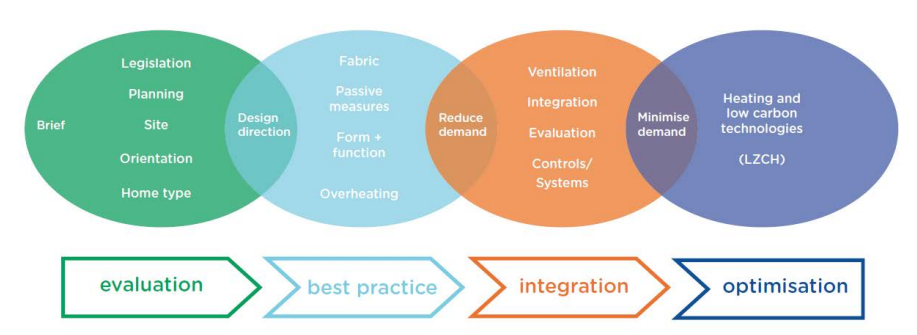
First three processes was discussed on the previous posts. The following stage after all the planning, fabric, overheating, ventilation etc problems have been considered, is heating and low carbon technologies. The purpose of this last section is to reduce the energy savings on heating the space and water. Thus, the better house is insulated the lower demand for heating energy will be required. Also, according to the UK Government's set targets, the CO2 emission needs to be reduced as well. Hence, to complete both requirements low carbon technologies should be installed when building new dwellings or refurbishing the old ones.


These tables shows the consumption of hot water and time water is heated per hour in a single dwelling. It leads to the conclusion that the largest demand of water is between 7am to 11am and 4pm to 8pm. This, also, means that on those hours the biggest amount of energy will be required to heat the water and it will take longer to heat the cold water over and over again. The same with the space: the bigger the space, the more energy and time will be required to heat it. However, all new build and refurbished homes could benefit from the use of low temperature water systems fed by heat pumps or condensing boilers which supply heat more efficiency, renewable solar energy,
underfloor heating systems which heats the space faster, etc.
Condensing boiler
The main working principle is to heat the water with the energy which is emitted as the hot gasses goes through a heat exchanger and cools and condenses them. This, also, reduce the heat loss.

However boiler works efficiently only if the flow and return temperature is kept below 55C. Thus, it is a good back up heating system combined with other.

Solar water heating (solar thermal) system
It consist of solar panel (collectors) which might be mounted on the pitch roof or be fixed to the frame on a flat roof, hot water cylindeer, pump and controller. The solar panels collect the heat from the sun which is passed to the fluid inside the collectors. Then it is pumped to the hot water cylinder, where the cold water is heated up and pumped to the taps. This system is the most effective in summer period when it is possible to heat about 90% of hot water use. However, the boiler still be needed to back up system.

Heat pumps
Ground source heat pumps
Heat from the ground is extracted from the underground by pumping water mixed with anti-freeze through it. Then the temperature of the fluid is increased by the heat pump and the water is passed to provide home heating (usually underfloor heating or radiators) or hot water (boiler).

Ground source heat pump is quite expensive and it requires excavation and a good knowledge of the site ground condition to install. Pipe work laid out horizontally about 1.5m below the surface or vertically in boreholes between 20 - 150m.
Air source heat pump
The pumps are placecd outside to collect the the heat prom the air. Then, the air pump increase the temperature and pass the heat to radiators or underfloor heating system.
Both heat pumps need energy to run, however it is still energy efficient as pumps use less energy and emit less CO2 into atmosphere to produce heat than it would be provided by burning fuel.
There is many other new technologies and energy efficiency strategies from which sustainable homes could benefit such as solar panels, rainwater harvesting system, wind turbines etc. Sometimes it may look expensive and difficult to install and maintain it, but if the manufacturer instructions is followed and automatic control system is used the results should be seen in a short period (reduction of energy use and bills).
Case study
Greenwatt Way development has number of features focused on energy strategy to meet the Code level 6 for sustainable houses. This includes, MVHR system; rainwater harvesting and grey water recycling systems to provide water for toilet flush, irrigation and car washing; solar panels which provides renewable electricity for homes; air source heat pumps, ground sours heat pumps, biomass boiler, which all three of them works independently to demonstrate it can work separately and generate enough heat to fit the zero carbon standards; smart metering, etc.

References:
'Greenwatt way' [Online]
Availabe at: http://www.thisisconcrete.co.uk/home_page/case_studies/greenwatt_way.aspx
[Accessed at 17th of November, 2013]
‘Greenwatt Way. A zero carbon homes newbuild case study’,
2011. Energy saving trust.
‘Greenwatt way’ [Online]
Available at: http://www.house-builder.co.uk/documents/WILFORD-Chris.pdf
[Accessed at 17th of November, 2013]
‘Greenwatt way’ [Online] Available at: http://blog.emap.com/footprint/2011/10/13/a-visit-to-prps-greenwatt-way/
[Accessed at 18th of November, 2013]
Energy saving trust, 2011. ‘Here comes the sun: a field
trial of solar water heating systems’.
Energy saving trust, 2010. 'Getting warmer: a field trial of heating pumps'
Energy saving trust, 2010. 'Getting warmer: a field trial of heating pumps'


